
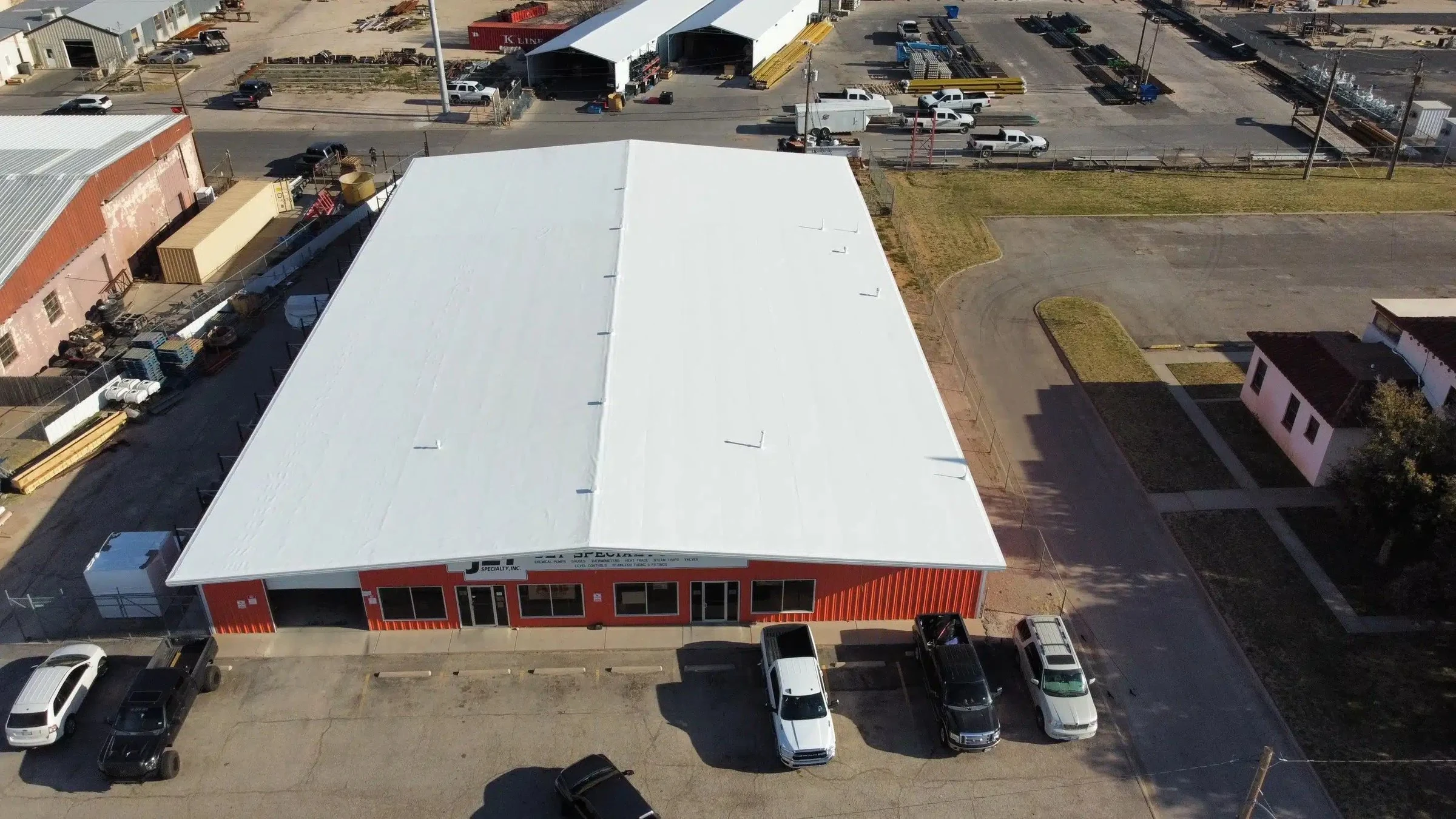
Roofing for Wood-Products Mills and Manufacturing Plants Near Eugene
The Willamette Valley's manufacturing base still runs heavily on wood products, and mill and plant roofs take a beating that office buildings never see: sawdust and wood fines settling into every low point, kiln and dryer heat pushing thermal cycling into the membrane, and steel building components that corrode fast once coatings start to fail under nine months of rain. We roof manufacturing buildings in and around Eugene with those production realities built into the plan, not treated as an afterthought.
Sawdust and Wood Fines on Low-Slope Membranes
Dust from planing, sanding, and material handling drifts and settles on roof surfaces near vents, dust collector stacks, and loading areas, and it doesn't stay put. Rain turns dry sawdust into a compacted mat that holds water against the membrane and clogs drain strainers. We see this most at roof edges downwind of dust collection equipment and around rooftop conveyor penetrations, where fines build up faster than anywhere else on the roof.
A membrane under a dust mat ages differently than one exposed to normal weather. UV degradation slows because the dust blocks sunlight, but moisture retention increases, which shifts the failure mode toward seam and fastener corrosion rather than surface breakdown. When we inspect a mill roof, we're checking conditions under the dust layer, beyond whatever's visible from a walk across the surface.
Thermal Cycling From Kilns and Process Heat
Dry kilns, boiler stacks, and process heat exhaust create localized hot zones on a plant roof that cycle through much wider temperature swings than the rest of the field membrane. That cycling stresses flashing details and can accelerate membrane fatigue right at the curb, faster than the manufacturer's general service life would suggest. Standing-seam metal and heavier-gauge single-ply systems handle that cycling better than thin, economy-grade membrane, and we spec accordingly wherever we know a section of roof sits near sustained process heat.
Corrosion on Metal Building Components
A lot of the manufacturing stock in this area is pre-engineered metal building construction, and once a factory-applied coating starts to chalk or scratch through, Willamette Valley rain gets to work fast. We check fastener heads, panel seams, and gutter systems for early corrosion on every inspection, because a corroding fastener is a leak point long before it's visually obvious from the ground.
- Drain and gutter capacity relative to actual roof area and downspout count
- Dust buildup depth at low points and around rooftop equipment
- Fastener and seam corrosion on metal panel roofs
- Flashing condition at kiln, boiler, and dust collector penetrations
- Membrane condition beneath any accumulated dust or debris mat
- Skylight and smoke vent seal integrity in production areas
Scheduling Around Production Shifts
Most plants around Eugene run multiple shifts, and a roof crew working overhead during production hours is a safety and noise problem for the floor below. We plan tear-off, fastening, and any work involving equipment shutdowns around production schedules the plant manager gives us, and we keep roof access points clear of material handling paths so forklift and conveyor operations aren't disrupted.
Emergency work is different. A leak over a finished-goods storage area or an electrical room doesn't wait for a planned shutdown, and we treat those calls as urgent regardless of what shift is running when the call comes in.
Insurance Documentation for Industrial Property
Manufacturing facility insurance policies often carry roof-specific conditions, particularly around maintenance records and age of the system. We document inspection findings and any repair work with photos and written scope, which gives a plant manager or risk manager something concrete to reference if a claim ever needs supporting evidence. We don't promise a particular claim outcome, but a documented maintenance history is the difference between a straightforward claim and a disputed one.
That documentation matters even more on plants that have expanded in phases over the years, since a roof built as three or four separate additions often has different system types, different install dates, and different remaining service life across sections. We keep records section by section rather than treating a multi-addition roof as one uniform system, since a claim or a maintenance decision on one wing shouldn't get tangled up with the condition of a completely different part of the building.
Common Questions About Manufacturing Plant Roofing
Can you work around a plant that never fully shuts down?
Yes. We coordinate with production schedules and typically stage tear-off and fastening work for the least disruptive shift window, keeping equipment and material paths clear throughout.
How do you handle sawdust and debris buildup during a repair?
We clear the work area before diagnosing the membrane underneath, since debris on top of a roof can mask or mimic damage that isn't actually there. Ongoing dust management on a production roof is usually a maintenance-interval question we discuss separately from repair scope.
Do you work on pre-engineered metal buildings?
Yes, a large share of the industrial stock around Eugene is metal building construction, and we inspect and repair panel seams, fasteners, and gutter systems as part of standard plant roof service.
What roof systems hold up best near kiln or boiler heat?
Standing-seam metal and heavier-gauge single-ply membranes generally tolerate thermal cycling from process heat better than lighter economy membranes, and we spec system thickness based on proximity to known heat sources on the roof.
Can you provide documentation for our insurance file?
Yes. We provide written inspection and repair records with photos that a plant manager or risk manager can keep on file for maintenance history and claims support.