
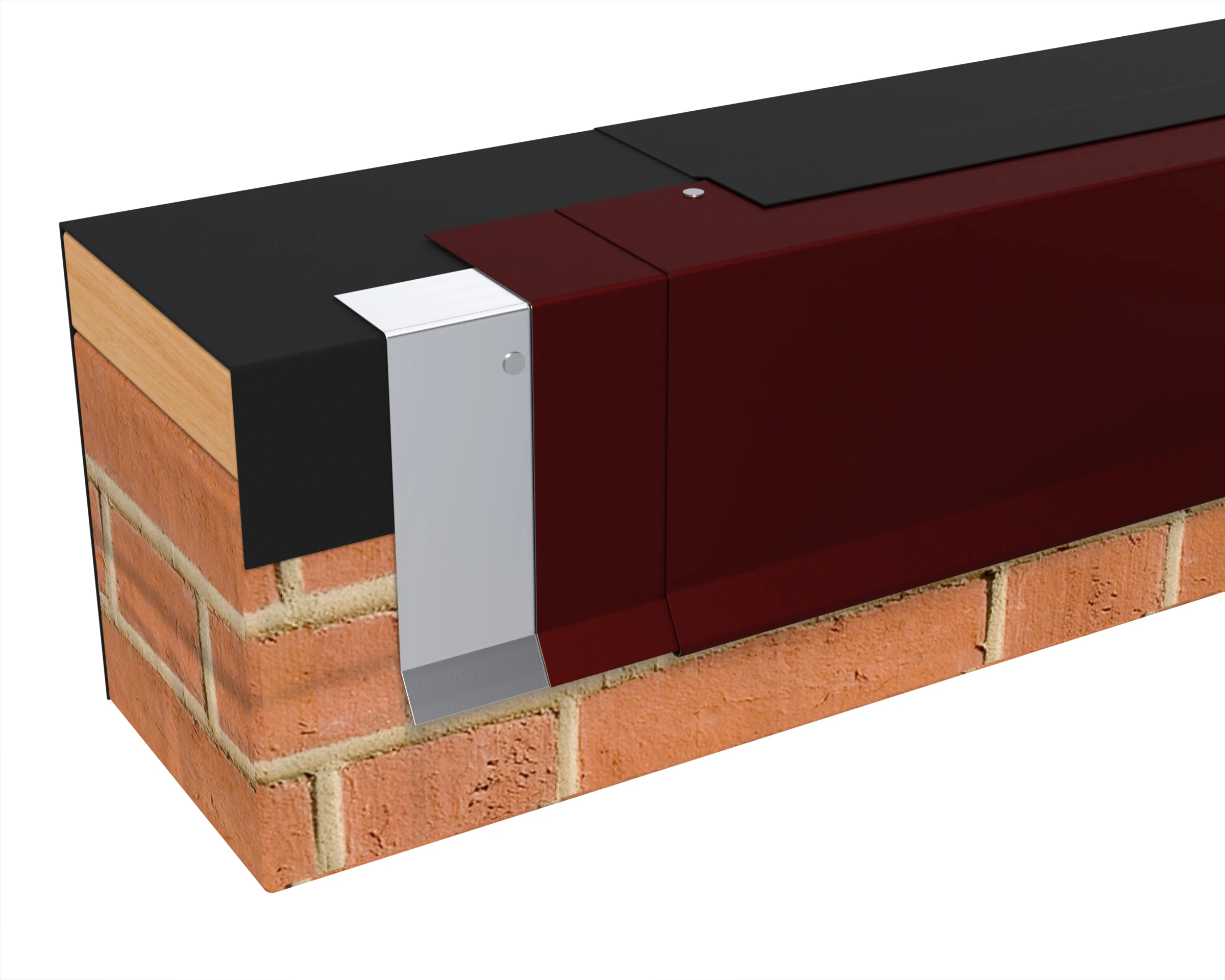
Edge Details That Fail First Under Constant Rain
Field membrane on a well-maintained roof can outlast the metal and gutter details around its perimeter by years. Edge metal, coping, and gutters take direct wind and water exposure that the flat field of the roof doesn't see in the same way, and in a market with this much sustained rainfall, they're often the first thing to need attention.
Why Edge Metal Fails Before the Field Membrane Does
Edge metal sits at the transition point where wind uplift forces concentrate, and it takes direct water flow off the roof surface every time it rains. Fasteners loosen over years of thermal movement, seams between sections open slightly, and once water gets behind the metal it doesn't dry out between storms the way an exposed membrane surface does. We see edge metal failures well ahead of comparable field membrane problems on the same roof more often than the reverse.
Fastener spacing on older edge metal installs often falls short of what current wind uplift standards call for, which is something we check regardless of whether a building has had recent storm damage. Tightening up fastener spacing during a routine repair is a relatively small addition to the job that meaningfully reduces the odds of an edge failure during the next windstorm.
Coping Seams and Ice Storm Movement
Parapet coping seams move with temperature swings all year, but an ice storm accelerates that cycle considerably. Ice forms in a seam gap, expands, and can pry the joint open slightly wider than it was before the thaw. Repeated over a few winters, this is how a coping seam that was watertight when installed starts letting water behind the wall. We check coping seams specifically after any ice event, since the damage is often subtle until it's let water in for a season or two.
Gutter and Downspout Capacity for Willamette Valley Rain Volume
A gutter system sized adequately for a drier climate can be undersized here simply because of how much water it has to move during a heavy rain event. Downspouts that discharge too slowly back water up into the gutter, which then overflows at the weakest point, often right at a building corner or over an entrance. We evaluate gutter and downspout capacity against actual local rain volume rather than assuming the existing system was sized correctly when it went in.
Debris Load From Fir Needles and Leaf Litter
Gutters and edge details collect the same needle and leaf debris that clogs roof drains, but in a gutter the effect is more visible: an overflowing gutter during a storm usually means it's dammed somewhere along its run. We clear this as routine maintenance where a client has us on a schedule, and we check for it specifically on any edge metal or gutter repair call, since a clogged gutter puts standing water directly against edge metal seams that aren't designed to handle prolonged wet contact.
Repair vs. Full Edge Replacement
Not every edge metal problem needs full replacement. Loose fasteners can be reset, individual seam sections resealed, and isolated coping cap damage repaired without pulling the whole perimeter. But once corrosion or repeated seam failure shows up across multiple sections of the same run, patch repairs stop being cost-effective and a full edge metal or coping replacement becomes the more sensible path. We lay out both options with what each actually addresses rather than defaulting to the larger scope.
Material choice matters on replacement projects too. Prefinished aluminum and galvanized steel both hold up to the valley's rain exposure when properly detailed, but the seam and fastening details make a bigger difference over the long run than the base metal choice does. We spec continuous cleat systems where they fit the building's edge profile, since they reduce the number of exposed fasteners that can loosen or corrode over time compared to face-fastened edge metal.
- Loosened fasteners from years of thermal movement
- Coping seams pried open by freeze-thaw cycling
- Gutters undersized for sustained heavy rain volume
- Downspouts backing up and overflowing at building corners
- Needle and leaf debris damming gutter runs
- Corrosion or repeated seam failure across multiple edge sections
Edge and Gutter Questions
How often do gutters need to be cleared in Eugene?
Most buildings with nearby tree cover need clearing at least twice during the wet season, once before the fall needle drop and once mid-winter as debris continues to accumulate.
Can a coping seam be resealed instead of replaced?
Often yes, if the damage is isolated. Once seam failure shows up repeatedly across a run, or corrosion has set in, replacement becomes more practical than ongoing resealing.
How do I know if my gutters are undersized?
Consistent overflow during heavy rain, even when the gutter isn't visibly clogged, usually points to a capacity issue rather than a debris problem. We evaluate the system against actual rain volume before recommending an upsize.
Does edge metal damage affect the roof warranty?
It can, depending on the manufacturer and how the edge metal is detailed into the membrane system. We repair edge details in a way that keeps the overall system warranty intact where one is in place.
Why does my gutter overflow at one specific corner every storm?
That's usually a sign of a blockage or undersized downspout at or near that corner backing water up faster than it can drain. We trace it to the specific point rather than clearing the whole run and hoping it resolves.