
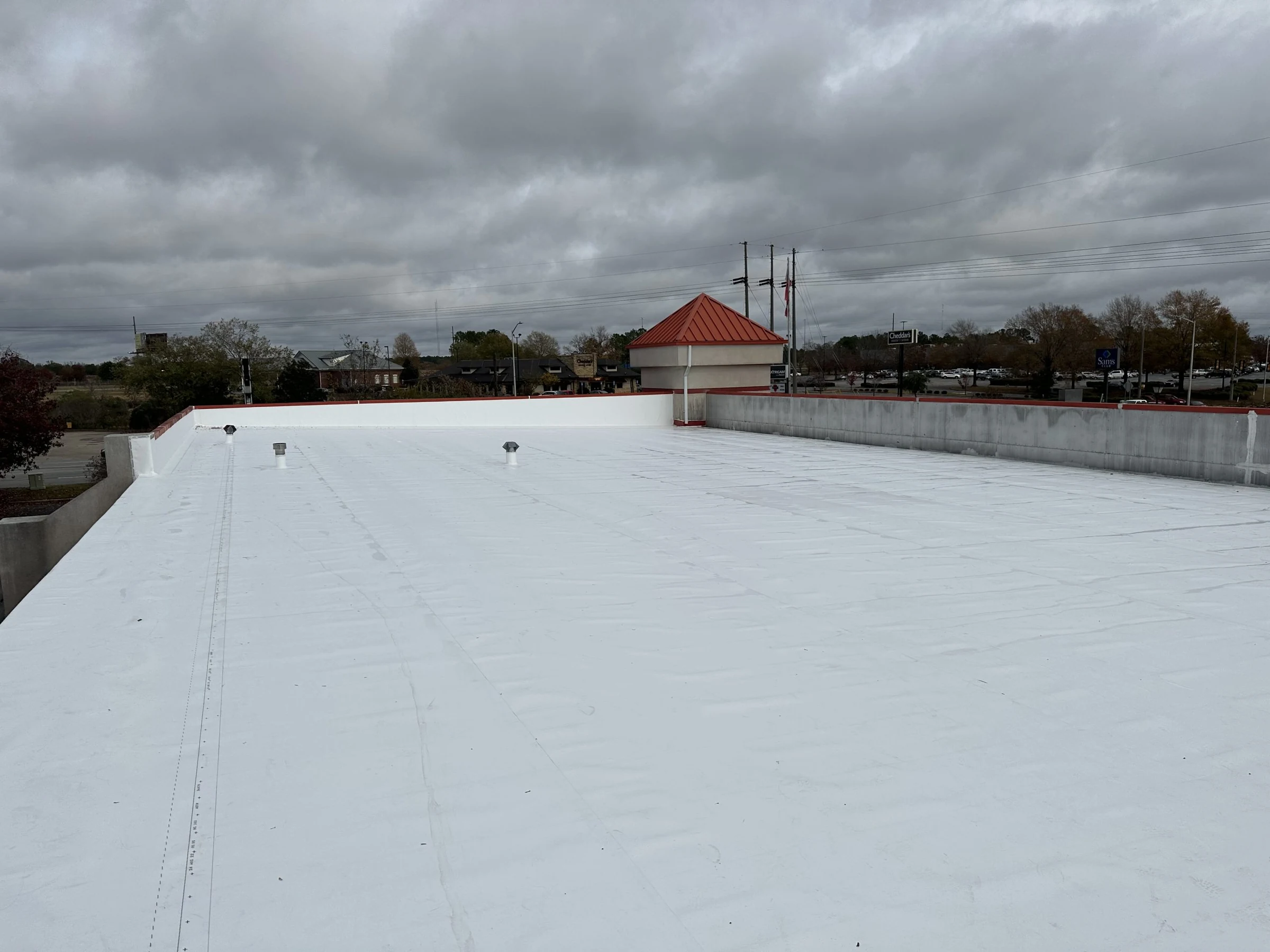
PVC Membrane for Roofs With Grease, Chemical, or Ponding Exposure
PVC shares TPO's heat-welded seam method but adds better resistance to oils, greases, and certain chemicals, which puts it on our shortlist for restaurant roofs, food-processing space, and industrial buildings around the wood-products corridor where airborne residue lands on the membrane over time. It costs more than TPO for a comparable sheet, and we reserve it for roofs where that resistance actually matters.
Why Chemical Resistance Matters Here
Kitchen exhaust grease is the most common reason we spec PVC over TPO locally, since restaurant rooftop exhaust deposits a film that degrades standard thermoplastic membrane faster than a PVC sheet formulated to resist it. Standalone restaurant buildings along major retail corridors and multi-tenant strip centers with a food-service anchor are the clearest case for PVC.
Wood-products and light manufacturing buildings around west Eugene sometimes produce airborne resin or solvent residue that settles on nearby roofs, and where that's a documented condition, PVC's chemical resistance earns its higher cost over a standard TPO sheet.
Heat-Welded Seams in Constant Rain
PVC seams weld the same way TPO seams do, forming a continuous fused bond rather than a taped or adhesive lap. That matters in a climate where the roof stays wet more days than dry for a good chunk of the year, since the seam's integrity doesn't depend on an adhesive holding up under sustained moisture the way EPDM's does.
We probe every weld during installation and follow up during the roof's first full wet season, the same practice we use on TPO, because a marginal weld on a PVC roof behaves the same as one on TPO: it holds during a dry-day inspection and opens under real rain pressure.
Ponding Water and Long-Term Membrane Performance
PVC handles occasional ponding better than most alternatives, which makes it a reasonable choice on roofs with a known low spot that isn't practical to fully correct in the current budget cycle. That said, we still address drainage and slope as the primary fix and treat the membrane's ponding tolerance as a safety margin, not a design strategy.
On flat industrial roofs where full re-sloping isn't in scope, we've specified PVC specifically because its ponding tolerance buys the owner more years before drainage work becomes unavoidable.
- Heat-welded seams, same fused-bond method as TPO
- Better resistance to grease, oils, and certain chemicals than TPO
- Best fit for restaurant, food-service, and light-manufacturing roofs
- Handles occasional ponding better than most alternatives
- Smooth surface resists moss better than textured membranes
- Higher material cost than TPO, justified by exposure conditions
Moss and Organic Debris on a Smooth Surface
Like TPO, PVC's smooth surface sheds general debris and resists moss establishment better than granulated or textured membranes. Roofs under mature canopy near the university and older commercial blocks still accumulate organic material in valleys and around curbs, and moss will take hold there over a couple of wet seasons without maintenance.
Because PVC roofs often carry chemical or grease exposure that also needs periodic cleaning, we typically combine moss control with the grease-cleaning schedule on restaurant and food-service roofs rather than treating them as separate maintenance items.
Cold Tolerance and Occasional Ice
PVC stiffens in hard cold similar to TPO, and the Valley's occasional ice storms call for the same precaution: we avoid non-emergency foot traffic and repair work on PVC roofs during active freezes and schedule inspections beforehand instead.
Flashing terminations and equipment curbs are where ice accumulation concentrates stress on any membrane, and PVC is no exception. We check those details specifically during fall inspections on roofs with a history of winter ice.
Restaurant and Food-Service Roof Considerations
Standalone restaurant buildings and multi-tenant strip centers with a food-service tenant as the primary draw are where PVC earns its cost most consistently in our experience locally. Kitchen exhaust deposits grease across the roof surface within a defined radius of the exhaust fan, and a standard TPO membrane degrades noticeably faster in that footprint than PVC formulated to resist it.
We map out where exhaust deposits land during the initial roof inspection so the PVC membrane, and any additional cleaning schedule, gets specified around the actual exposure pattern rather than treating the whole roof as uniformly at risk. Similarly, buildings near wood-products processing or light manufacturing sometimes have airborne resin, solvent, or particulate exposure that settles on nearby roofs over time. Where that's a documented, ongoing condition rather than an isolated incident, PVC's chemical resistance is worth the added cost over standard TPO, and we say so plainly during the proposal stage.
Questions on PVC Roofing for Eugene Buildings
When does PVC make more sense than TPO here?
Mainly on roofs with grease exposure from kitchen exhaust or chemical residue from nearby manufacturing. Without that exposure, TPO usually delivers similar performance for less cost.
Does PVC resist standing water better than TPO?
Both perform reasonably well against occasional ponding, and PVC has a slight edge in long-term chemical resistance under those conditions. Neither substitutes for correcting a genuine slope problem.
How do PVC seams hold up through a wet Willamette Valley winter?
The heat-welded seam is a fused bond rather than an adhesive, which holds up well under sustained moisture. We verify every weld during installation and again in the first wet season.
Is PVC roofing more expensive than TPO?
Yes, typically. We only recommend it where grease, chemical, or ponding conditions justify the added cost over a standard TPO sheet.
Does PVC need different winter maintenance than TPO?
Not meaningfully. Both stiffen in hard cold and both benefit from pre-winter inspection of flashings and drains rather than repair work during an active freeze.