
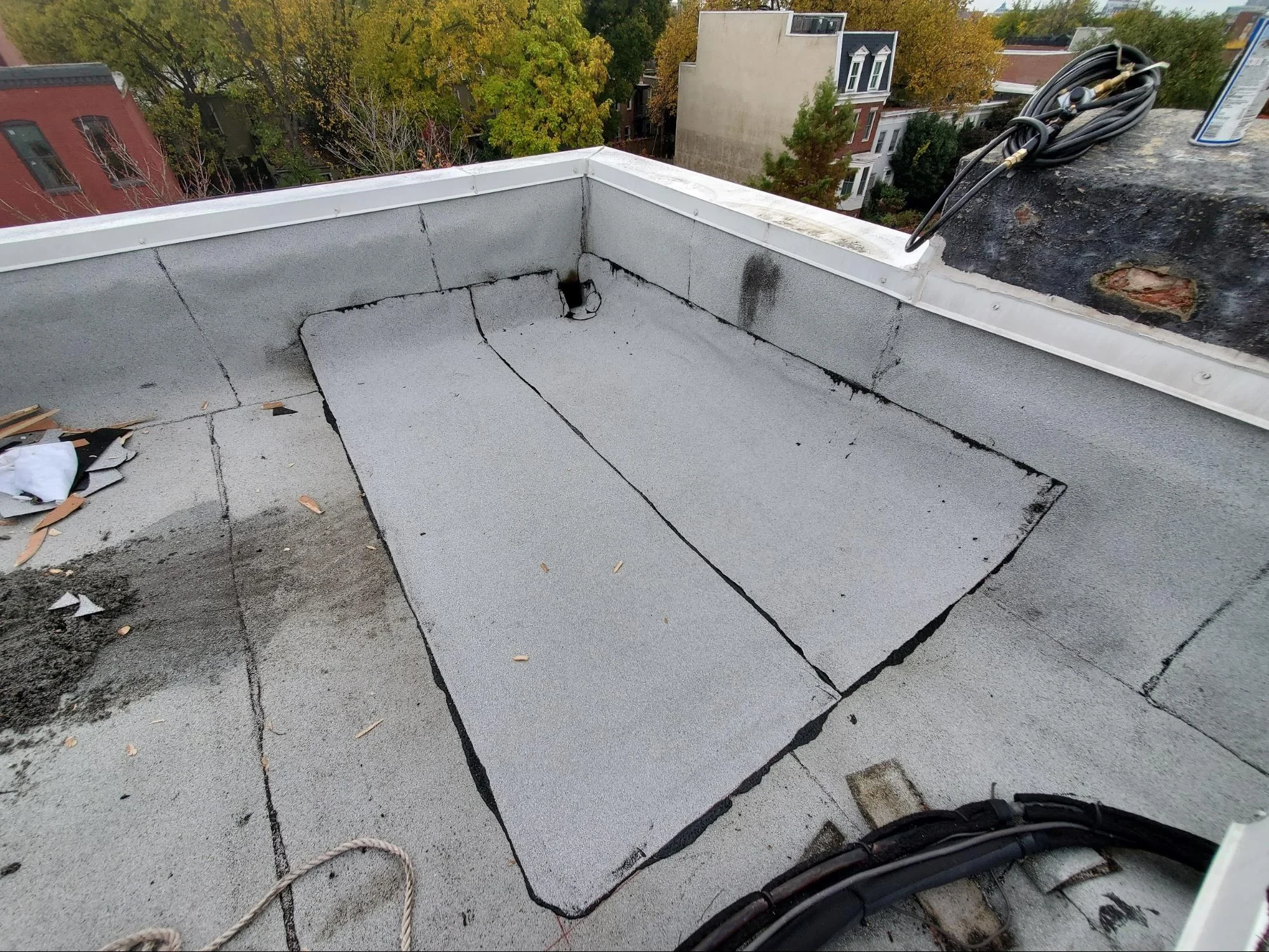
Keeping Water Moving Off Low-Slope Roofs Nine Months a Year
Drainage is the single most important system on a low-slope roof in a market that sees rain most of the year. A membrane can be in good condition and still fail early if the drains and scuppers meant to move water off it aren't keeping up. We check drainage first on almost every service call, regardless of what the visit was originally scheduled for.
Why Drainage Is the First Thing We Check
A roof's slope only moves water as far as the nearest functioning drain. If that drain is clogged or undersized, water backs up across the field regardless of how well the membrane itself is holding up. We've seen otherwise sound roofs develop leaks simply because a single drain bowl was packed with debris and water had nowhere to go but sideways under a seam. Checking drains takes minutes and tells us more about a roof's actual condition than almost any other single inspection point.
Internal drains buried inside the building envelope get less attention than surface-mounted ones simply because they're harder to see, but they carry the same risk. A clogged internal drain can back water up into the drain leader itself, which sometimes shows up as a ceiling leak nowhere near the roof edge and gets misdiagnosed as a membrane failure until someone actually checks the drain.
Moss and Needle Buildup Around Drain Bowls
Drain bowls collect debris the same way gutters do, but the consequences are more direct since a fully blocked drain has no overflow path unless a scupper or secondary drain is present. Fir needles, moss fragments, and leaf litter accumulate in the bowl and around the strainer basket, and in a wet climate that debris stays saturated and compacted rather than drying and blowing clear. We clear drain bowls as a routine part of maintenance visits and check them specifically after any storm with significant wind, since that's when debris load tends to shift.
Ponding Water and What It Does to Membrane Over Time
Water that sits on a membrane for more than about 48 hours after a rain event starts to accelerate wear at that specific spot, well beyond what the surrounding dry membrane experiences. Ponding also adds weight the roof structure carries longer than it was necessarily designed for, and it gives algae and moss an ideal spot to establish. When we find a persistent ponding area, we look at whether it's a clogged drain, a low spot in the deck, or both, since the fix is different depending on the cause.
Overflow Scuppers as a Backup, Not a Fix
Overflow scuppers exist to give water somewhere to go if the primary drain fails or can't keep up during a heavy rain event. They're a safety measure, not a substitute for keeping the primary drainage system clear. A roof that's relying on its overflow scuppers regularly during normal rain, rather than only in genuinely heavy events, has a primary drainage problem that needs to be addressed directly rather than accepted as normal.
Retrofitting Drainage on Older Low-Slope Roofs
Some of the older commercial buildings around Eugene were built with drainage systems sized for a different roof configuration than what's there now, sometimes after additions, rooftop equipment installs, or prior reroofing changed how water moves across the surface. When we find a roof with persistent ponding that isn't explained by a simple clog, we evaluate whether additional drains or a tapered insulation system to correct the slope would solve the problem at the source rather than requiring repeated maintenance to manage a design limitation.
Rooftop additions are a common trigger for this kind of mismatch. A new HVAC unit, a solar array, or an added mechanical curb can change how water moves across a roof that was draining fine before the addition went in, redirecting flow toward a drain that wasn't sized for the new volume or creating a dam effect on the upslope side of the new equipment. We factor drainage impact into any conversation about adding rooftop equipment, alongside the structural load question that usually gets asked first.
- Drain bowls and strainer baskets cleared of needle and moss debris
- Ponding areas tracked across inspection visits
- Scupper function checked as backup, not primary drainage
- Low spots evaluated for deck versus drainage causes
- Additional drain or tapered insulation options for chronic ponding
- Post-storm debris checks after significant wind events
Drainage Questions
How much standing water on a roof is a problem?
Water that hasn't drained within about 48 hours of the last rain is worth investigating. Occasional shallow ponding right after a storm that clears quickly is less concerning than water that lingers.
How often should drains be cleared in this climate?
At minimum before the wet season starts in fall and again mid-winter. Roofs under heavy tree cover often need more frequent attention.
Are overflow scuppers required on every roof?
Most low-slope commercial roofs are designed with a secondary drainage path, whether scuppers or additional drains, as a safety measure against primary drain failure. We check that the system in place matches what the roof actually needs.
Can adding more drains solve a chronic ponding problem?
Sometimes. It depends on whether the ponding is caused by insufficient drain capacity or by a low spot in the deck itself. We evaluate the specific cause before recommending additional drains versus a tapered insulation fix.
Does a clogged drain void my roof warranty?
Manufacturer warranties generally expect reasonable maintenance, which includes keeping drains functional. Chronic ponding caused by neglected drainage can be a factor if a warranty claim is ever contested.